Craps Dice Mechanics: How Random Number Algorithms Shape Virtual Table Experiences Today
Written by Finley Becker · Aug 6, 2026
Craps Dice Mechanics: How Random Number Algorithms Shape Virtual Table Experiences Today
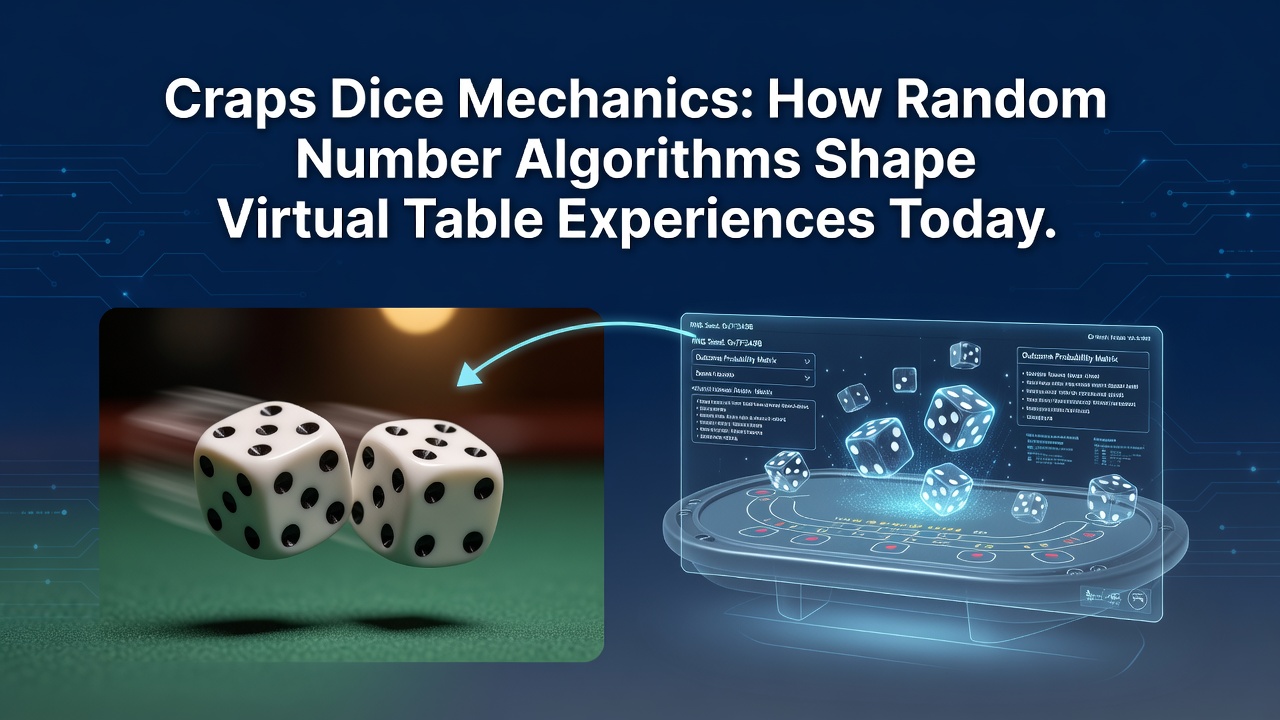
Virtual craps relies on random number generators that replace physical dice with algorithmic sequences, and these systems determine every outcome at online tables across regulated markets. Developers integrate pseudorandom number generators into game engines so that each roll produces results statistically indistinguishable from fair six-sided dice, while platforms must meet strict testing standards before launch.
Core Mechanics of Digital Dice Simulation
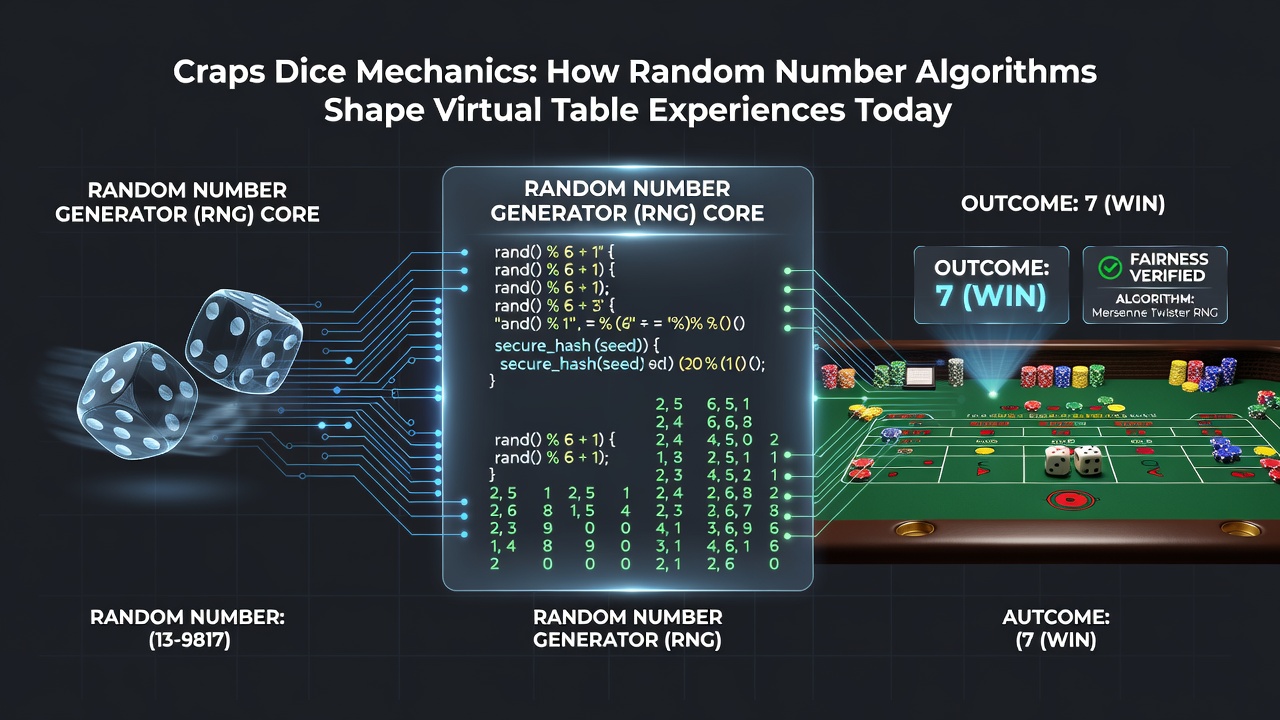
Traditional craps uses two physical dice whose faces combine to create sums from two through twelve, and virtual versions replicate this distribution through code that maps generated numbers to dice faces. A typical implementation draws an integer from a large range, applies modular arithmetic to produce values between one and six for each die, then displays the corresponding animation so players see results appear in real time. Because the underlying sequence comes from deterministic calculations seeded by system entropy such as hardware timestamps or environmental noise, the output remains unpredictable to users yet verifiable during audits.
Engineers often combine multiple entropy sources to initialize the generator state, and this practice reduces the chance that an observer could reconstruct future rolls from past results. In practice, the algorithm runs continuously in the background, advancing its internal state with each query from the game server, which ensures that even consecutive rolls remain independent events.
Algorithms Commonly Deployed in Current Platforms
Many virtual craps titles employ the Mersenne Twister or more recent variants such as PCG and Xoshiro families because these generators pass extensive statistical test suites required by certification labs. The Mersenne Twister offers a period length exceeding 2^19937 minus one, which far surpasses the number of rolls any single table will process over its lifetime, while newer algorithms reduce memory usage and improve speed on mobile devices without sacrificing randomness quality. Developers map the raw output to dice values using unbiased techniques like rejection sampling, which discards values that would favor certain faces and thereby preserves exact 1/6 probability for each outcome.
Some studios layer additional cryptographic hashing steps on top of the base generator to meet jurisdiction-specific rules that demand forward and backward secrecy, meaning knowledge of one roll reveals nothing about previous or subsequent rolls. These layered approaches appear frequently in platforms operating under multiple licenses simultaneously.
Certification Standards and Regulatory Oversight
Independent laboratories evaluate RNG implementations before deployment, running millions of simulated rolls to confirm that observed frequencies align with theoretical probabilities within acceptable confidence intervals. Regulators in North America and Australia require periodic re-testing, often annually or after any software update, to maintain ongoing compliance. Data from the Nevada Gaming Control Board shows that approved systems must demonstrate uniformity across the full range of possible dice combinations before operators receive authorization to offer the game to the public.
Platforms that serve players across borders must also satisfy requirements set by bodies such as the Alcohol and Gaming Commission of Ontario, which publishes technical standards covering both the RNG core and the client-server communication that delivers results. These rules address latency, audit logging, and resistance to tampering attempts, ensuring that the virtual experience mirrors the integrity expected at physical tables.
How Algorithm Design Influences Player Experience
Fast generation allows tables to resolve bets within milliseconds, which supports high-volume play without the physical delays inherent in handling real dice. Animations built around the RNG output add visual feedback that keeps sessions engaging, yet the underlying math remains constant regardless of graphical flair. Because the system can generate rolls on demand, operators offer features such as rapid-fire modes or multi-roll previews that would be impossible with physical equipment, and these options expand the ways participants interact with the game.
Security measures embedded in the RNG pipeline protect against both external attacks and internal manipulation, while transparent reporting of test results builds trust among players who review certification seals displayed on game pages. In August 2026 several North American jurisdictions updated their RNG audit frequency requirements, prompting providers to implement real-time monitoring dashboards that flag statistical deviations faster than traditional batch reviews allowed.
Future Directions in Randomization Technology
Research groups continue to explore quantum random number generation for gambling applications, although current deployments still rely on classical algorithms because quantum hardware remains expensive and not yet scaled for widespread commercial use. Hybrid systems that combine quantum entropy sources with established PRNGs appear in pilot programs run by select operators, and early results indicate these approaches could further strengthen resistance to prediction attempts. Industry reports from organizations such as the Gaming Standards Association highlight ongoing work to standardize interfaces between RNG modules and game engines, which should simplify certification across different regulatory environments.
Conclusion
Random number algorithms form the foundation of every virtual craps outcome, translating mathematical sequences into the familiar dice rolls that players expect. Through rigorous testing, certification, and continuous oversight by agencies in multiple regions, these systems deliver consistent fairness while enabling the speed and feature variety that define modern online tables. As technology advances, the core requirement remains unchanged: each roll must occur independently and without bias so that the virtual experience continues to reflect the statistical integrity of the physical game.