From Riverboats to Servers: How Craps Mechanics Adapted Across Eras of Gambling Regulation

Observers note that craps mechanics evolved alongside shifting regulatory frameworks, moving from informal dice games on riverboats in the 1800s to structured table play in licensed casinos and later to server-based random number generators in regulated online environments, and data from multiple jurisdictions shows these adaptations maintained core probability structures while incorporating new oversight requirements.
Origins on Riverboats and Early Regulatory Pressures
Researchers have documented that craps originated from older dice games brought to America by French colonists, and on Mississippi riverboats during the mid-19th century operators ran games with physical dice and simple payout tables while authorities in various states imposed restrictions that pushed gambling onto waterways where federal jurisdiction often prevailed over local laws. Those who've studied this era observe that mechanics relied on manual dice rolls and verbal betting calls, yet enforcement varied widely because riverboats could relocate between ports to avoid crackdowns.
Evidence indicates that by the late 1800s several states enacted outright bans on dice games, which forced operators to refine layouts and betting sequences so games could resume under new local tolerances once political climates shifted. Figures from historical records reveal that payout ratios for pass line bets stabilized around even money plus odds, a structure that carried forward because regulators later accepted it as a standard for fair play calculations.
Transition to Land-Based Casinos and Standardized Oversight
After riverboat operations declined, craps found new footing in Nevada following legalization in 1931, and experts point out that state licensing boards required physical tables, trained dealers, and documented procedures for dice inspection to prevent tampering. Those who've examined licensing archives note that mechanics expanded to include multiple proposition bets with fixed house edges, while surveillance protocols emerged to verify every roll and settlement.
Studies found that Atlantic City adopted similar rules after its 1976 legalization, and regulatory bodies in both jurisdictions mandated uniform table dimensions plus dice specifications that ensured consistent bounce and randomness. Data shows these standards reduced disputes and created a template other states later referenced when they authorized casino gaming in teh 1990s and early 2000s.
Digital Platforms and Server-Based Adaptations
Once internet connectivity advanced, craps moved to online servers where random number generators replaced physical dice, and regulatory agencies in several regions required independent testing labs to certify algorithms for uniform distribution across millions of simulated rolls. Observers note that live dealer streams later combined video feeds with digital betting interfaces, allowing players to see actual dice while software handled payouts and record-keeping.
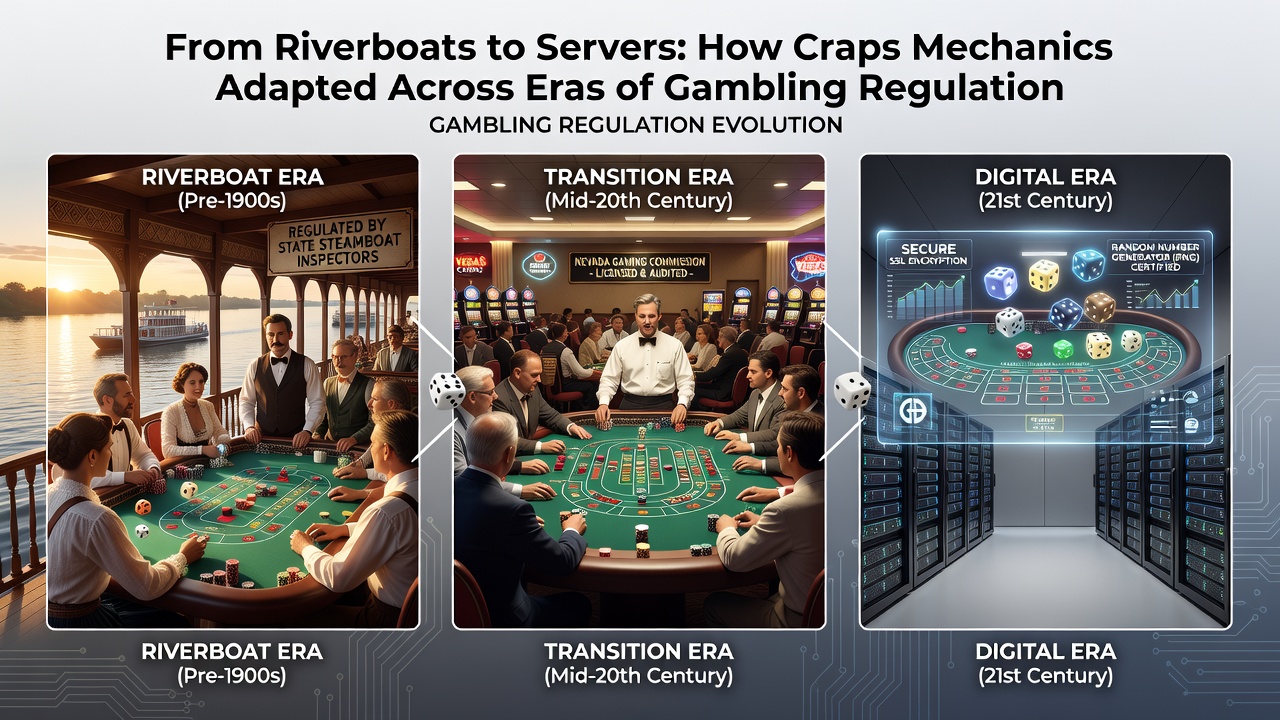
According to reports from the Nevada Gaming Control Board, licensed online operators must maintain audit trails that capture every transaction and random outcome, which mirrors the documentation once required only at physical tables. In Ontario the Alcohol and Gaming Commission introduced similar technical standards that demand real-time monitoring of server integrity, and industry data indicates these rules helped stabilize player confidence during expansion periods.
What's interesting is how mechanics adapted without altering fundamental probabilities, since pass line house edges remain near 1.41 percent in both land and digital formats once optimal odds bets are included. Researchers discovered that software interfaces added features such as instant replay and bet history logs, features that regulators later accepted as tools for dispute resolution.
Regulatory Milestones Through 2026
By July 2026 several additional jurisdictions had integrated craps into multi-state compacts that harmonized testing protocols for random number generators, and reports from the American Gaming Association show that these agreements reduced redundant audits while preserving each state's licensing authority. Observers note that server-side mechanics now routinely include geofencing and identity verification layers that earlier riverboat operators never needed, yet the underlying dice outcome distribution stayed mathematically identical.
Figures released by Australian state regulators demonstrate comparable adaptation timelines, where online craps products underwent mandatory fairness certifications before public release. Those who've reviewed compliance filings observe that cross-border operators adopted unified reporting formats to satisfy multiple oversight bodies simultaneously, which streamlined operations without changing core game mathematics.
Conclusion
Evidence across two centuries shows that craps mechanics retained their probabilistic foundation while regulatory demands shaped delivery methods from riverboat dice to server algorithms, and data continues to confirm that each transition incorporated verification steps suited to the technology of its time. Those who track regulatory evolution note that the pattern persists as new jurisdictions evaluate online authorization frameworks.