Pattern Detection in Dice Roll Sequences for Virtual Craps Gaming
Written by Leon Vogel · Jul 7, 2026

Pattern Detection in Dice Roll Sequences for Virtual Craps Gaming
Online craps platforms rely on random number generators to simulate dice rolls, and sequence analysis examines how those rolls unfold over thousands of outcomes to verify expected distributions. Researchers apply statistical tools such as runs tests and autocorrelation measures to identify whether successive results align with theoretical probabilities derived from two six-sided dice, which produce 36 possible combinations with varying frequencies for totals ranging from two to twelve.
Core Methods Behind Sequence Examination
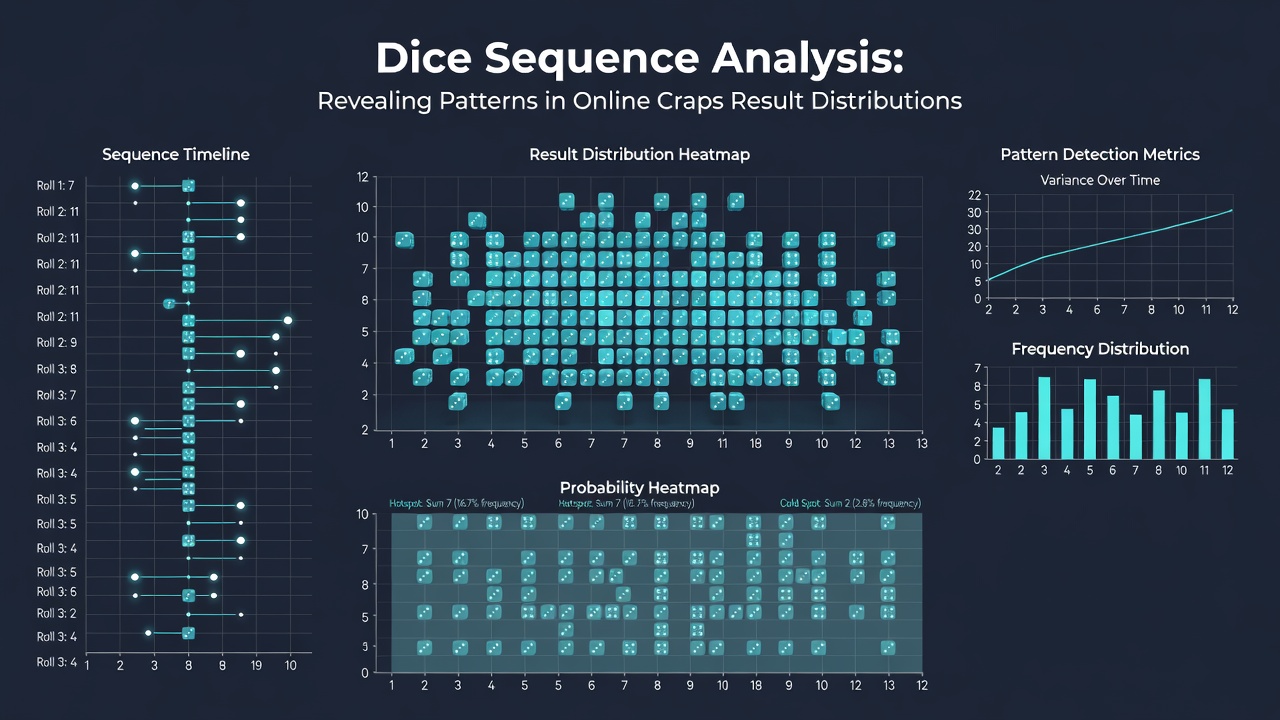
Analysts collect large datasets from certified RNG systems, then segment the data into rolling windows of consecutive rolls to calculate frequency counts for each total and compare those counts against the known probability curve where seven appears most often at roughly 16.67 percent. Markov chain modeling tracks transitions between one outcome and the next, revealing whether the system maintains independence across rolls or introduces subtle dependencies that deviate from random expectations, while chi-square goodness-of-fit tests applied to binned sequences confirm overall uniformity.
Observed Distribution Behaviors in Digital Environments
Studies of live platform logs show that short-term clusters of repeated totals occur at rates consistent with binomial expectations, yet longer sequences occasionally produce streaks that prompt further scrutiny even though such streaks remain within normal variance bounds. Data compiled across multiple operators indicates that the distribution of point-establishment rolls versus seven-outs follows the 24/36 versus 12/36 split predicted by combinatorial math, and deviations beyond two standard deviations appear rarely enough to support continued certification of the underlying generators.
Software tools developed by testing laboratories automate the extraction of n-gram sequences, allowing observers to scan for overrepresentation of specific patterns such as consecutive hardways or extended runs without sevens. When these scans flag anomalies, engineers re-seed the RNG or adjust entropy sources to restore statistical equilibrium, a process that regulatory bodies in multiple jurisdictions require on a periodic schedule.
Regulatory Oversight and July 2026 Developments
By July 2026 several North American and Australian oversight agencies had updated their technical standards to mandate quarterly sequence audits for all licensed online craps titles, citing improved computational capacity that permits deeper examination of multi-million-roll datasets. Reports released that month from the Nevada Gaming Control Board highlighted how one operator's platform maintained outcome independence across 50 million simulated rolls, while a parallel review by the Australian Communications and Media Authority confirmed similar compliance among domestic-facing sites.
University-affiliated research groups have contributed independent verification by publishing anonymized sequence datasets that allow external statisticians to replicate findings. One such repository maintained by a Canadian academic consortium supplies timestamped roll logs stripped of player identifiers, enabling cross-validation of distribution curves without compromising operational security.
Practical Applications for Platform Operators
Operators integrate sequence monitoring dashboards that surface real-time alerts when rolling averages drift outside preset tolerance bands, prompting immediate review before certification windows close. These dashboards combine heat-map visualizations of recent totals with trend lines tracking the ratio of pass-line wins to don't-pass wins, giving technical teams an at-a-glance view of whether current play aligns with historical baselines derived from earlier audit periods.
Training programs for compliance staff now include modules on interpreting autocorrelation plots and interpreting p-values from runs tests, ensuring that personnel can distinguish between ordinary random fluctuation and genuine generator faults. Such preparation reduces response times when sequence anomalies surface during high-volume promotional events that generate unusually large sample sizes in compressed timeframes.
Conclusion
Sequence analysis continues to serve as a cornerstone verification technique for online craps, confirming that digital dice behave according to established probability models while satisfying evolving regulatory benchmarks. Ongoing refinement of analytical methods, supported by data from multiple geographic jurisdictions, sustains player confidence in the fairness of each roll sequence generated by certified systems.